
You know the feeling — that dull, pressure-filled heaviness sitting just behind your eyes and across your cheekbones that no amount of steam inhalation or antihistamines quite resolves. For many people across Mumbai and Navi Mumbai, this is not an occasional inconvenience. It is a recurring reality: blocked nasal passages in the morning, a foggy head throughout the day, headaches that announce themselves before the weather changes, and a sensitivity to dust and pollution that makes city living quietly exhausting.
What most people do not realise is that Ayurveda has a dedicated therapy for exactly this region of the body — one that targets the nasal passages, sinuses, and the broader head-neck axis with a directness that systemic treatments simply cannot achieve. That therapy is Nasya.
What Nasya Actually Is — And What It Isn’t
Nasya is one of the five classical Panchakarma therapies. Its name comes from the Sanskrit word nasa, meaning nose, and the nose, in Ayurvedic medicine, is considered the direct gateway to the brain and the entire region above the clavicle, referred to as Urdhwajatru. Nasya involves the administration of medicated oils, herbal preparations, or powders through the nasal route, allowing the therapeutic substances to reach and act on the sinuses, nasal passages, throat, eyes, ears, and the nervous system above the neck.
This is not a nasal spray in the common sense. Nasya is a structured therapeutic procedure — preceded by preparatory treatments, carried out with precise technique, and followed by post-procedure care. Done correctly, it is one of the most targeted and effective Ayurvedic treatments available for the conditions it addresses. Done casually or without proper guidance, its benefits are significantly diminished.
The Ayurvedic Understanding of Sinus Problems and Headaches
Ayurveda does not see chronic sinusitis or recurring headaches as isolated problems. They are viewed as expressions of deeper imbalances — most commonly an aggravation of Kapha dosha, sometimes with Vata involvement, and often compounded by accumulated Ama (toxins) in the upper respiratory channels.
Kapha, in its balanced state, is responsible for lubrication, cohesion, and protection. When it becomes aggravated — by cold and damp weather, a heavy diet, irregular sleep, or the air quality typical of dense urban environments — it thickens and stagnates. In the nasal and sinus passages, this manifests as congestion, excessive mucus, post-nasal drip, a blocked or running nose, and the characteristic facial heaviness of sinusitis.
Vata aggravation, on the other hand, tends to produce a different picture: dry nasal passages, more neurological headaches, tension around the temples and back of the head, and often a connection to stress and sleep disturbance.
Here is where things get clinically interesting: most conventional sinusitis management focuses on reducing infection or clearing mucus. Ayurvedic Nasya treatment targets the underlying dosha imbalance — which is why, in chronic and recurring cases, it tends to produce longer-lasting improvement than symptom-only management.
Types of Nasya and When Each Is Used
Nasya is not a single fixed procedure. There are several types, each suited to different conditions and constitutions.
Pratimarsha Nasya
This is the mildest and most commonly recommended form — a few drops of medicated oil (usually Anu Taila or Sesame oil) applied into each nostril daily. It is used preventively and as a maintenance practice, particularly beneficial during seasonal transitions and for those living in polluted urban environments. Many Ayurvedic physicians recommend it as part of a daily routine (Dinacharya) for people prone to sinus sensitivity.
Marsha Nasya
A slightly stronger dose of medicated oil is used therapeutically for chronic conditions. It reaches deeper into the nasal passages and is more appropriate for sustained treatment under clinical supervision.
Shodhana Nasya (Cleansing Nasya)
This is the more intensive therapeutic Nasya, involving herbal preparations that actively cleanse and detoxify the nasal and sinus passages. It is typically prescribed for acute sinusitis, heavy congestion, nasal polyps, and chronic mucus accumulation. Shodhana Nasya produces a more pronounced cleansing response and is always carried out in a clinical setting.
Shamana Nasya (Palliative Nasya)
Used to pacify and soothe rather than cleanse — typically with medicated ghee preparations. This form is more appropriate for Vata-related headaches, dry nasal passages, neurological symptoms, and general head and neck tension.
The choice between these types, and the specific preparation used, depends entirely on the individual’s dosha profile, symptoms, and overall health status. This is why the assessment by a qualified Ayurvedic physician is not a formality — it is foundational to getting results.
What Nasya Treatment Addresses
In our experience, patients who come for Ayurvedic Nasya treatment in Navi Mumbai are dealing with one or more of the following, and it is worth understanding how Nasya addresses each.
Chronic and Recurrent Sinusitis
Nasya works directly on the sinus passages — clearing accumulated mucus, reducing inflammation of the mucosal lining, and improving drainage. The medicated preparations used in Shodhana Nasya have antimicrobial, anti-inflammatory, and mucolytic properties that act locally and precisely. Patients with chronic sinusitis who undergo a full Nasya course, combined with appropriate dietary changes, consistently report significant reductions in the frequency and severity of episodes.
Headaches and Migraines
Not all headaches originate in the head — many are driven by tension, congestion, or neurological Vata imbalance in the neck and upper spine. Nasya reaches the base of the brain via the nasal pathway and exerts a direct calming and decongestive effect on this region. For Kapha-type headaches (heavy, dull, pressure-based, worse in cold weather), cleansing Nasya is particularly effective. For Vata-type migraines (throbbing, one-sided, associated with stress and light sensitivity), palliative Nasya with medicated ghee tends to offer more sustained relief.
Allergic Rhinitis and Dust Sensitivity
For those whose sinuses react to dust, pollution, pollen, or seasonal changes, Nasya — particularly regular Pratimarsha Nasya — strengthens the mucosal barrier and reduces reactivity over time. It is not an antihistamine; it works by building resilience in the nasal tissue rather than suppressing an immune response.
Cervical Spondylosis and Neck-Related Headaches
This is a connection that surprises many patients. The Urdhwajatru region that Nasya acts upon includes not just the sinuses but the throat, cervical spine area, eyes, and ears. Patients dealing with neck stiffness, cervicogenic headaches, or upper back tension often find that Nasya — as part of a broader Panchakarma programme — contributes meaningfully to symptom relief in these areas too.
Cognitive Clarity and Mental Fatigue
This benefit is less discussed but consistently reported. Because Nasya preparations act on the nervous system above the neck — and the nasal pathway has a direct anatomical relationship with the olfactory nerve and brain — regular Nasya tends to improve mental clarity, reduce brain fog, and support better quality sleep. In Ayurveda, the nose is quite literally described as the door to the mind.
The Treatment Process at Dr. Janugade’s Clinic
A Nasya session at Dr. Janugade’s Ayurvedic Panchakarma Centre in Thane and Vashi, Navi Mumbai, begins well before the actual procedure.
The preparatory phase (Purvakarma) involves gentle facial and neck massage with warm medicated oil, followed by localised steam fomentation over the face and sinuses. This loosens congested mucus, relaxes the facial and neck muscles, and opens the nasal channels so that the therapeutic preparation can travel deeper and act more effectively.
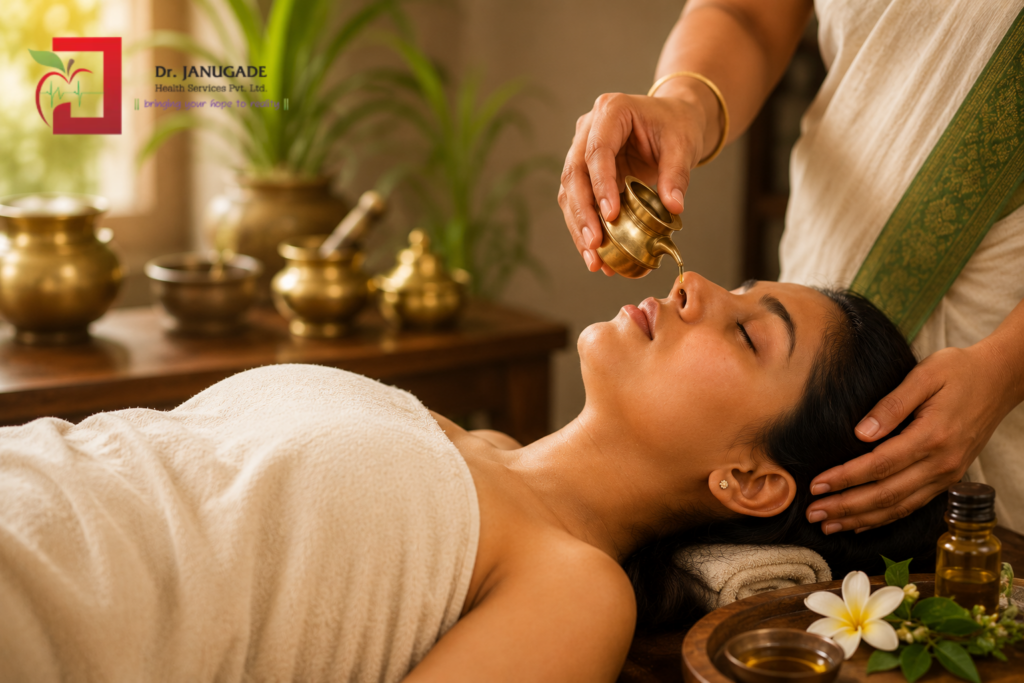
The Nasya preparation — selected based on the patient’s specific condition and dosha profile — is then warmed and administered as drops into each nostril, with the patient lying in a slightly reclined position. A brief period of rest follows, during which the preparation works through the upper nasal passage into the sinus cavities. Post-procedure care includes gargling, gentle expectoration, and specific dietary and lifestyle guidance for the day.
A typical Nasya course runs from seven to twenty-one days, depending on the severity of the condition. In chronic cases, two or more courses may be recommended across a season. Progress is assessed at each stage, and the preparation or approach is adjusted if needed.
Why Getting This Right Matters
The nasal passage is not a simple entry point — it is a sensitive, highly vascularised channel connected directly to the sinuses, the throat, the eustachian tubes, and neurological structures in the brain. Nasya performed with the wrong preparation, in the wrong proportion, or without appropriate pre-treatment can cause irritation rather than relief.
At Dr Janugade’s clinic, every Nasya course is preceded by a thorough consultation with Dr Archana Janugade, who brings over 24 years of Panchakarma experience to every treatment plan. The preparations used are authentic and carefully formulated. Nothing here is generalised — the therapy is always tailored to the individual.
A Thought Worth Sitting With
Sinus problems and recurring headaches are among the most underestimated quality-of-life disruptors — partly because they are not dangerous enough to demand urgent attention, but persistent enough to quietly wear a person down. Conventional management often keeps them at bay without resolving them. Ayurvedic Nasya treatment in Navi Mumbai approaches the problem differently: not by suppressing what the body is expressing, but by restoring the conditions under which the sinuses can function without constant inflammation and blockage.
If you have been managing these symptoms for months or years and are looking for a structured, root-cause approach, a consultation at Dr. Janugade’s clinic is worth your time. The nose, as Ayurveda has long understood, is closer to the brain than most people think — and treating it well has effects that extend far beyond the sinuses.