
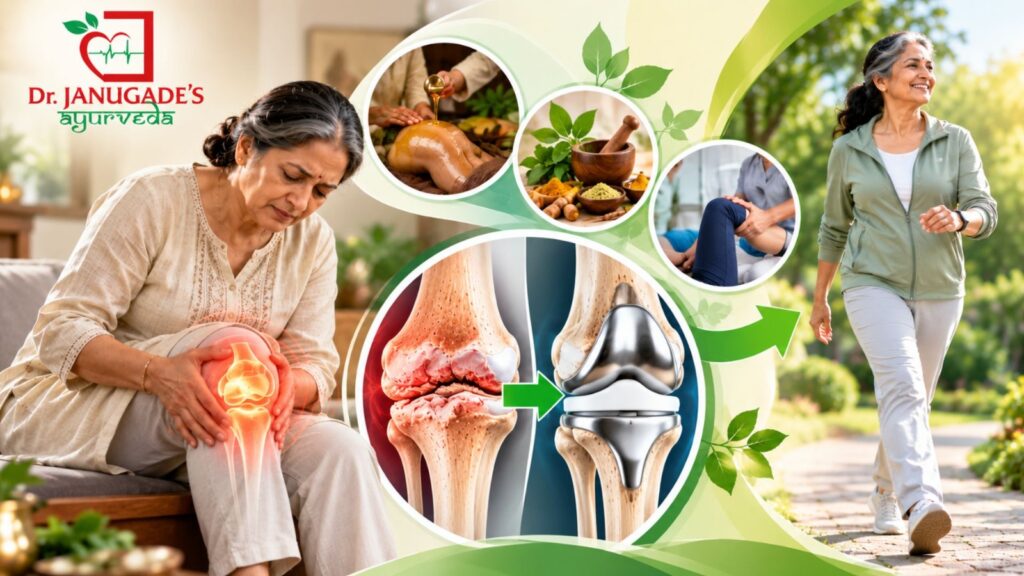
When knee pain starts limiting your movement, stairs, work or daily routine, the thought of knee replacement can become stressful. Understanding your condition and exploring suitable non-surgical approaches can help you make a more informed treatment decision. Osteoarthritis Ayurveda Doctors in Navi Mumbai provide personalised Ayurvedic care based on your symptoms, mobility and overall needs.
When osteoarthritis starts making everyday movement harder, getting the right guidance can help you understand your available treatment options. At Dr. Janugade’s, Osteoarthritis Ayurveda Doctors in Navi Mumbai provide personalized Ayurvedic care with Panchakarma Treatment and Basti Treatment based on individual needs.
What Is Knee Osteoarthritis?
Knee osteoarthritis is a condition where cartilage (the protective lining that covers the bones) within the knee joint starts to wear away, resulting in pain, stiffness and loss of knee movement.
As the condition progresses, everyday activities such as walking, climbing stairs, standing for long periods, squatting or exercising can become increasingly difficult. Ongoing symptoms may also impact mobility, activity and general independence, and early evaluation and timely management is crucial.
What Symptoms Can Knee Osteoarthritis Cause?
Osteoarthritis of the knee is a very common condition which causes pain, stiffness and a restriction in movement especially when pressure is put on the joint. Symptoms may slowly disrupt walking, stairs, exercise, work and other everyday activities.
Common symptoms include:
- Lack of pain with weight-bearing on the knee.Pain on the knee while moving.
- Stiffness after rest
- Knee pain that makes it hard to bend or straighten the joint
- Reduced walking tolerance
- Difficulty climbing stairs, or pain from this activity.
- Has trouble with daily tasks.Has problems with basic activities of daily living.
Practical example: An individual who used to be able to walk around without any problems may begin to avoid longer walks, stairs, or recreational activities due to the pain.
What Does Knee Replacement Surgery Involve?
When the damage to a knee joint is severe and causes pain and problems, the knee may need to be replaced with a knee replacement surgery. If you are planning to undergo Osteoarthritis Ayurveda Doctors in Navi Mumbai, it is important that you know the procedure to make informed decisions about your treatment.
Key points include:
- Artificial joint: Damaged parts of the knee are replaced by artificial parts.
- Relieving pain: The aim of the procedure is to alleviate chronic knee pain and enhance joint function.
- Mobility: The improved knee function can make it easier to walk and carry out daily activities.
- If you think about it: Surgery is considered when pain, loss of use or damage to the joints greatly interfere with quality of life.
- Recovery: It is important to rehabilitate and slowly recover following the procedure.
- Treatment decision: Assessment of condition, pain and mobility, and the effect on daily living before surgery is recommended.
When Do Doctors Recommend Knee Replacement?
Knee replacement surgery with Osteoarthritis Ayurveda Doctors in Navi Mumbai is recommended when knee pain, damage to the knee joint and limited motion become a problem for daily activities after the right non-surgical treatment.
These may be based on:
- If the knee pain is ongoing or severe.
- Problems with walking or climbing stairs
- Restrictions on activities of daily living that are significant.Markedly limited in activities of daily living.
- Significant joint damage
- Poor response to conservative treatment
- Lower standard of living
This should be based on good clinical judgement, not symptoms.
Is Knee Replacement the Only Treatment Option?
No, knee replacement is not the only option for every person with knee osteoarthritis. Treatment depends on the severity of the condition, symptoms, mobility, joint damage and response to non-surgical approaches.
Before surgery becomes necessary, patients can discuss options such as:
- Activity modification
- Appropriate physical activity
- Weight management when relevant
- Symptom management
- Physiotherapy or rehabilitation
- Suitable complementary approaches
For patients exploring Osteoarthritis Ayurveda Doctors in Navi Mumbai, Ayurvedic care can be discussed as part of a personalised non-surgical management plan.
Can Ayurveda Help Manage Osteoarthritis?
Osteoarthritis Ayurveda Doctors in Navi Mumbai offers a customized strategy for arthritis management utilizing treatments, solutions, diet and lifestyle suggestions tailored to every client. Dr. Janugade’s clinic has arthritis in its treatment areas and explains personalized Panchakarma treatment plans according to the health status and dosha profile.
Basti is also mentioned as a treatment in Ayurveda for arthritis and joint stiffness in the clinic.
It is not a promise that every patient will be able to avoid knee replacement, but rather its aim is to manage symptoms, support mobility and improve daily functioning.
What Non-Surgical Ayurvedic Options Can Help Manage Osteoarthritis?
Non-surgical Ayurvedic care can combine personalised Panchakarma therapies with supportive lifestyle measures to address pain, stiffness and mobility concerns. For those considering Osteoarthritis Ayurveda Doctors in Navi Mumbai, the approach can include:
- Panchakarma therapies: Treatment is planned according to individual health needs.
- Basti: A medicated therapy included as part of the Panchakarma approach.
- Abhyanga: Therapeutic oil massage used to support comfort and flexibility.
- Swedana: Herbal steam therapy used to help relieve stiffness and support mobility.
- Ayurvedic medicines: Herbal formulations may be selected according to individual requirements.
- Lifestyle guidance: Diet, suitable exercise, yoga, posture, stress management and adequate rest can complement treatment.
The Osteoarthritis Ayurveda Doctors in Navi Mumbaialso emphasises customised treatment, monitoring and follow-up, allowing the care plan to be adjusted according to the patient’s progress.
What Can You Try at Home to Ease Knee Pain?
Alongside effective treatment, there are certain daily habits that can help alleviate knee pain and optimize function. Home care should be used in addition to appropriate clinical evaluation and not in place of it.
Useful habits include:
- Maintain an appropriate level of activity.
- Try to avoid activities that will continue to bother the knee.
- Eat a well-balanced diet.
- Control weight, if necessary.
- Get sufficient rest breaks between strenuous activities.
- Follow your recommended treatment plan.
Common errors are avoiding movement entirely due to pain, beginning intense exercise too rapidly or continuing activities that always exacerbate pain.
When Should You Consider Knee Replacement Surgery?
Non-surgical treatments should be considered before knee replacement, and the procedure should be seriously considered when persistent pain or advanced joint damage and limited mobility persist and significantly affect your quality of life.
It becomes important to discuss surgical options when:
- Pain does not get better and is still very painful.
- It’s harder to walk.
- Walking and normal activities are curtailed.
- For this reason, no further improvement will be possible with non-surgical treatment.
- There is serious damage to the joints.
- Knee problems have a considerable impact on independence and quality of life.
In patients who visit the Osteoarthritis Ayurveda Doctors in Navi Mumbai, Ayurvedic medications could be discussed as a part of the treatment, but a proper orthopaedic evaluation is significant if the patient requires surgery.
How Can Ayurveda Support Recovery After Knee Replacement?
Osteoarthritis Ayurveda doctors in Navi Mumbai could also provide supportive Ayurvedic advice along with the recommended rehabilitation program following knee replacement surgery. The focus may be any of the following:
- Panchakarma & Basti: These are taken into account, based on the person.
- Abhyanga and Swedana: Forms part of the Ayurvedic treatment in the clinic for joint and muscle care.
- Diet & lifestyle: Advice for a healthy lifestyle after treatment.
- Follow up care: Individual follow-up based on the patient’s progress.
Surgeon’s follow-up and medication instructions should not be ignored, but should be incorporated into ayurvedic care.
Conclusion
Osteoarthritis can affect mobility, comfort and everyday independence, but knee replacement is not always the first option. Understanding your condition and considering suitable non-surgical approaches can help you make informed treatment decisions.
Osteoarthritis Ayurveda Doctors in Navi Mumbai at Dr. Janugade’s provide personalised Ayurvedic care for arthritis and joint-related concerns.
If you’re dealing with joint pain, back or neck discomfort, skin concerns, hair loss, sinus problems, headaches, PCOD/PCOS, fertility concerns, or other health issues, Dr. Janugade’s Ayurvedic Panchakarma Centre offers personalized care based on your individual needs.
Explore our specialised Ayurvedic treatments and Panchakarma therapies to understand which approach may be suitable for your concerns.
Contact us today to discuss your health needs and explore the right Ayurvedic treatment for you.
FAQ’s
Can Ayurveda help manage knee osteoarthritis?
Through carefully chosen therapies, medicines and lifestyle advice, Ayurvedic treatment offers personalised management of arthritis and joint-related issues.
Can Ayurveda prevent knee replacement?
Ayurveda is not advertised as a certain precautionary measure to avoid knee replacement. Surgery may be required based on the signs and symptoms, joint damage, and how well treatment works.
When is knee replacement recommended?
When pain, joint destruction or other functional problems persist and significantly impact a person’s quality of life despite proper non-surgical management, knee replacement is considered.
What Ayurvedic treatments are used for joint pain?
Dr. Janugade’s clinic says Panchakarma and Basti are one of the remedies for arthritis and arthritis related issues.
Can Ayurveda be used after knee replacement?
Appropriate coordination of the medical rehabilitation plan with Ayurvedic care can offer supportive wellness and lifestyle advice post surgery.