
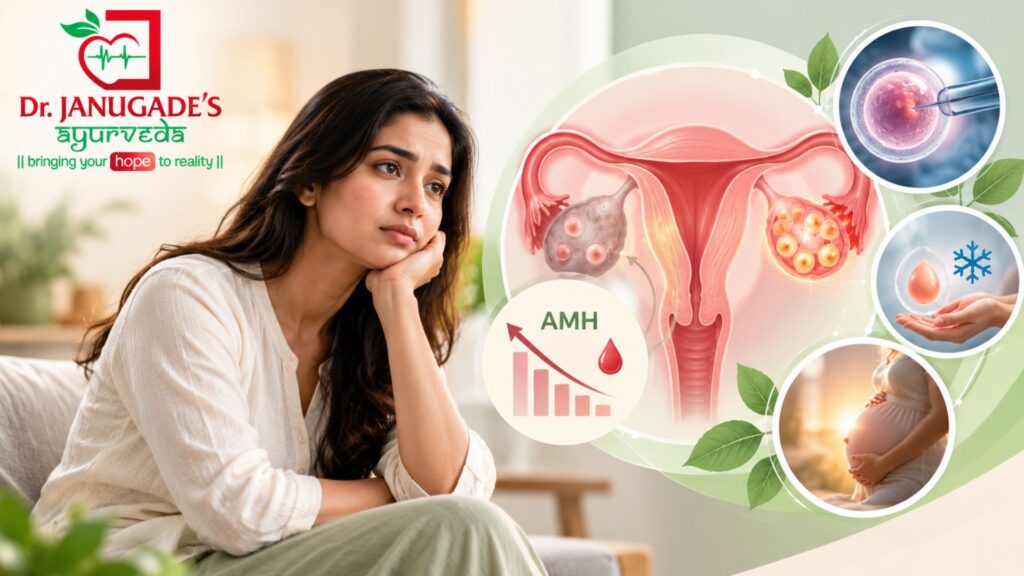
A low AMH result can raise concerns about ovarian reserve and the chances of pregnancy. However, low AMH does not automatically mean you cannot conceive. Understanding what the result indicates, reviewing your overall fertility health and exploring appropriate care options can help you make informed decisions. Infertility Ayurveda Doctors in Navi Mumbai can discuss individualised Ayurvedic care alongside appropriate medical fertility evaluation.
When a low AMH result leaves you questioning your chances of pregnancy, the right guidance can help you understand what comes next. At Dr. Janugade’s Infertility Ayurveda Doctors in Navi Mumbai provide personalized Ayurvedic infertility care with suitable therapies and supportive lifestyle guidance based on your individual needs.
What Is AMH and What Does It Tell You About Fertility?
Anti-Müllerian hormone (AMH) is a hormone produced by small ovarian follicles and is used as a marker of ovarian reserve.
AMH testing helps clinicians estimate the remaining egg quantity and anticipate how the ovaries might respond to fertility medication. However, it does not directly measure egg quality or determine whether natural pregnancy is possible.
What Does a Low AMH Level Mean?
Low AMH is a sign of a lower ovarian reserve than the respective laboratory reference range. It can also indicate that the ovaries are not stimulated to make as many eggs as may be necessary for IVF treatment.
But a low result does not mean that a person is definitely infertile or that his or her actual odds of becoming pregnant are low. Other factors, such as age, medical history, and ovulation, are also important.
When seeking advice from Infertility Ayurveda Doctors in Navi Mumbai, it is important to comprehend the test result as the foundation for suggesting appropriate treatment – not a sign that pregnancy is unattainable.
What Causes Low AMH Levels?
As women get older, AMH decreases, but this is not the only factor that can impact ovarian reserve.
As people get older AMH levels will naturally decrease, but the amount of AMH will differ between people of the same age. Ovarian reserve also may be impacted by a variety of other factors, such as prior surgery and some medications.
The potential reasons are:
- Age related changes: Ovarian reserve tends to decline with age.
- Surgery done on the ovary before: Some surgical procedures may have an impact on the ovary.
- Some medications: Medications that affect the ovaries can affect ovarian reserve.
- Individual variation: AMH levels vary from individual to individual and should be used in the context of the individual.
The underlying reason is not always clear. Infertility Ayurveda Doctors in Navi Mumbai can review your history and determine whether further assessment is appropriate.
Are There Any Symptoms of Low AMH?
Typically, low AMH does not have any distinct or obvious symptoms, and may be detected during a fertility evaluation.
It’s often found during fertility testing or when trying to get pregnant. Irregular periods may sometimes be a sign of a reproductive or hormonal issue, but not a sign of low AMH.
If you have any concerns about your menstrual cycle or fertility, the correct medical evaluation can help determine your underlying problem.
How Are AMH Levels Tested and Interpreted?
AMH is measured through a blood test and should be interpreted alongside other fertility factors rather than viewed in isolation.
| Assessment | What it helps evaluate |
| AMH blood test | Provides information about ovarian reserve. |
| Antral follicle count | Estimates visible small follicles through ultrasound. |
| Medical and menstrual history | Helps identify relevant reproductive factors. |
| Additional fertility tests | Assess other factors affecting conception when indicated. |
AMH can generally be measured at different points in the menstrual cycle. Because laboratory methods and reference ranges vary, discuss your result with a qualified fertility professional rather than interpreting a number in isolation.
Patients discussing their fertility concerns with Infertility Ayurveda Doctors in Navi Mumbai should also share relevant test reports and medical history during consultation.
Can You Get Pregnant Naturally With Low AMH?
Yes, there is a possibility of natural pregnancy even with low AMH as AMH is not the measure of fertility.
AMH is more beneficial when evaluating ovarian reserve and predicting ovarian stimulation response than for predicting spontaneous pregnancy.
Two women with the same AMH level can have different fertility situations, for instance, due to the fact that age, ovulation, the wellness of the sperm, the condition of the fallopian tubes and more also play a role in the achievement of pregnancy. AMH is not as informative as a complete assessment.
In cases where pregnancy is delayed, Infertility Ayurveda Doctors in Navi Mumbai can discuss Ayurvedic care, but it is crucial to consult a gynaecologist or fertility specialist to understand the options and timing.
How Does Ayurveda Approach Low AMH Management?
An individualized approach to infertility can be taken using Ayurvedic care, wherein health, lifestyle, diet and overall wellbeing are taken into account.
The following may be discussed, depending on the situation:
- Food consumption and nutrition advice.
- Stress management/relaxation techniques.
- Everyday life and overall health and safety.
- Treatment based on Ayurveda systems depending on the individual.
Such methods should not be touted as methods of raising AMH or rebuilding ovarian reserve. If you are thinking of using Ayurvedic medicine, consult with your fertility specialist, especially if you are taking medication or undergoing fertility treatment.
This distinction helps to keep the expectations realistic among the patients seeking Infertility Ayurveda Doctors in Navi Mumbai, and gives the chance for the Ayurvedic treatment to be considered rightfully.
Which Panchakarma Therapies May Be Considered for Low AMH?
Panchakarma therapies may form part of an Ayurvedic infertility-care plan when considered appropriate for the individual.
Dr. Janugade’s infertility treatment approach describes several Panchakarma and supportive therapies as part of its broader approach to infertility care.
The therapies described include:
- Virechana: A traditional purgation therapy.
- Basti: A medicated enema used in Ayurvedic practice.
- Uttar Basti: A specialised procedure involving administration through the genital or urinary route, depending on the clinical indication.
- Abhyanga: Therapeutic oil massage.
- Shirodhara: A traditional therapy involving a steady flow of liquid over the forehead.
How Does Dr. Janugade’s Ayurveda Approach Low AMH Care?
At Dr. Janugade’s it is our approach to understand the fertility issues of every woman initially before planning the Ayurvedic care. This strategy takes into account menstruation, hormonal issues, lifestyle, stress and general well-being.
Treatment involves Panchakarma therapies like Virechana and Basti, nutritional counselling, lifestyle advice and stress management, depending on the individual’s requirements under guidance of Infertility Ayurveda Doctors in Navi Mumbai
Infertility Ayurveda Doctors in Navi Mumbai will emphasize on giving appropriate ayurvedic advice, which aligns with the person’s fertility treatment process.
Why Consider Dr. Janugade’s Ayurveda for Fertility-Related Concerns in Navi Mumbai?
Dr. Janugade’s offers personalized Ayurvedic fertility treatment tailored to every patient’s unique fertility issues and requirements.
The focus of the approach is on:
- Treatment is tailored to the person, based on their concerns.
- Ayurvedic therapies: Depending on the patient’s need, suitable therapy is used.
- Lifestyle advice: Nutrition and lifestyle support.
- Aftercare: Progress is assessed throughout the treatment process.
- Patient care: Care that is focused on the comfort and cleanliness of the patient.
What Should You Know About Low AMH and Your Fertility Options?
Low AMH is a clue to ovarian reserve and doesn’t necessarily mean pregnancy isn’t possible.
Before deciding on treatment, you should think about:
- Interpret your outcome: AMH is one of the fertility assessment parameters.
- Consider other factors: Age, reproductive health are also important.
- Get expert advice: Consult with experts about your fertility issues.
- Discuss appropriate care: Ayurvedic support is discussed as appropriate to their needs.
Dr. Janugade’s is dedicated to providing Infertility Ayurveda Doctors in Navi Mumbai, and their team of experts provides personalized Ayurvedic infertility treatment and guidance throughout the fertility journey.
FAQ’s
What Should You Ask Infertility Ayurveda Doctors in Navi Mumbai About Low AMH?
Infertility Ayurveda Doctors in Navi Mumbai can explain your AMH report and talk with you about if Ayurvedic therapy is right for you along with your fertility assessment.
Can Infertility Ayurveda Doctors in Navi Mumbai Help With Low AMH?
In Ayurvedic care, anyone with fertility issues or problems is provided with personalised support regarding lifestyle, overall wellbeing and fertility issues. It shouldn’t be described as a tried and tested approach to boost AMH or replenish ovarian reserve.
What Causes AMH Levels to Become Low?
A common denominator is age-related changes. Ovarian surgery or some kinds of medicines may also impact the ovarian reserve.
Does Low AMH Cause Any Symptoms?
It does not normally result in any symptoms of its own. It is usually diagnosed by a blood test when men and women are undergoing fertility testing.
Can Infertility Ayurveda Doctors in Navi Mumbai Help With Low AMH?
A doctor of Ayurveda in Navi Mumbai can offer tailored Ayurvedic treatment for various fertility issues, such as appropriate therapies, lifestyle advice, and general wellbeing. Ayurvedic treatments must not be marketed as a “cure” for low AMH or ovarian reserve.
Which Ayurvedic Treatments Are Used for Low AMH?
As part of its infertility-care approach, Dr. Janugade explains therapies like Virechana, Basti, Abhyanga, and Shirodhara. Each case must be evaluated on a case by case basis.